
Current Account Deficits Are Not Always Bad
And Current Account Surpluses Are Not Always Good

In recent weeks, our focus has largely been on the cross section of balance of payments and FX. This is rooted in my firm belief that this is what is important right now, with international investment positions being key to determining capital flows, thus currency movements, at the moment.
We dived into this last week, noting that the large net international investment position (NIIP) surpluses of many countries – especially in Asia – have been core to currency movements. For instance, capital flows (either capital repatriation or hedging) have likely been the driver of the major strengthening for the Taiwanese dollar and the Korean won, while they pushed the Hong Kong Monetary Authority to implement and insane monetary loosening cycle to defend the USDHKD managed band of 7.75-7.85. A massive increase in liquidity by the HKMA has led to one month HK interbank rates (HIBOR) falling from 4.06% on 29 April to 1.33% on 16 May. That’s 260bps ish of easing. Mad.
Meanwhile, large NIIP deficit countries have seen major outflows over recent months which has driven FX weakness. This has largely been the product of the success of right-wing populists in Turkiye and Romania, and we could probably make the argument this applies for the US too as the sell US trade kicked in.
This is best summarised in this great chart from Brent Donnelly (who FYI has a few amazing trading books). NIIP balance has been well correlated with currency performance since 2 April.
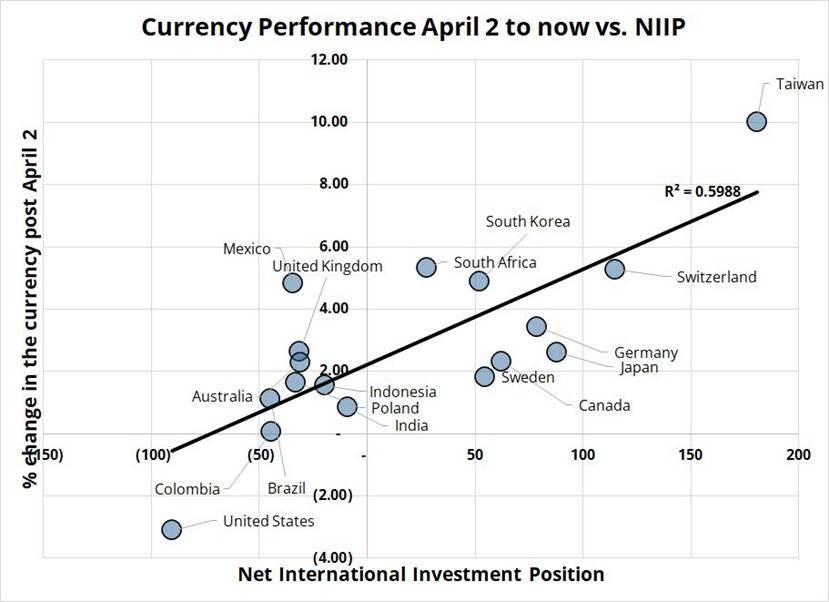
NIIP balances here appear to be a good indicator of currency performance, although for the record I think there’s likely more value at looking at external liabilities in isolation to examine vulnerabilities – a country’s portfolio liabilities will be internationally financed debt and equity largely from that country’s corporate sector and government. Portfolio assets which are held by other corporates in the country are not going to be a great amount of use to help servicing those liabilities in case of a BOP event, so why should we consider net over gross? That isn’t to say Brent should have charted gross values here (that wouldn’t have worked well) – the chart is nice as is.
ANYWAY, I’m writing this note to try to convince you that a popular BOP notion does not make sense. That is the idea that current account deficit = bad; and current account surplus = good. Last week, we bemoaned the lack of good BOP analysis, and this is a key issue among that.
First of all, it’s worth noting that in the current non-Bancor global set up, economic adjustment does occur in BOP deficit countries while there is no proportionate punishment for being a large surplus country (e.g. deindustrialization occurs in the US because it has a persistent large CA deficit while there is no punishment for CA surplus countries).
However, that does not mean that all current account surpluses and deficits are created equally. We care much more about what ultimately happens with the cash money if the current account is in surplus or how financing is found if in deficit, i.e. we care about what happens in the financial account more so than we do the current account. And we have four different versions of this, so buckle up lol.
Before we do, as a reminder, in balance of payments we have
Current account + capital account + financial account + net errors and omissions = 0
The current account is largely trade flows, the financial account is our financing, and net errors is where dodgy financing inflows run through if you don’t want to properly report those Russian investment inflows loool.
I like to rearrange that equation as
Current account + financial account + net errors and omissions = - capital account
Reducing to
financing needs = - financial account
i.e. you finance your external needs via the financial account, or if you have a trade surplus, your outflows run through your financial account.
Within the financial account, we have
financial account = portfolio investment balance + foreign direct investment (FDI) balance + other investment balance + change in central bank reserves.
This shows us that our country’s financing needs (which are largely driven by the current account) are financed via the financial account, and are either going to be investment flows (port, FDI, or other) or movements in reserves.
OK heeere we go. Four setups:
1. Current account deficit, financed by investment inflows. This situation can actually be good. A country can for a while finance a current account deficit by attracting inward investment. This means investment flowing into the economy which might be used to finance productive investment and ultimately drive up productivity in the economy. This can especially be good if the financing is FDI, which is much stickier than portfolio investment. The issue here only really comes when there are questions over whether the country can repay its external liabilities – in this context, a few years of even large current account deficits could be fine or even beneficial for the country. For examples, I’d look to Eastern Europe and the US, which sustained high growth rates, likely driven to a decent extent by high investment inflows which were the flipside of current account deficits.
2. Current account deficit, financed by reserve drawdowns. This is where it gets sticky. A current account deficit which is not being offset by investment inflows must be financed by central bank reserve drawdowns. These are necessarily limited, so the country is on a timer. In this category, I’d throw in the two countries we mentioned in our intro which have (almost?) had BOP events this year, Turkiye and Romania.
3. Current account surplus, financing investment outflows. When we are considering current account surplus countries, the repercussions we are looking for are very different to our deficit countries. We care about the extent to which the surplus is entering the domestic economy. As it enters the domestic economy, it might would strengthen the domestic currency, ultimately reducing external competitiveness (some of this lost competitiveness might be offset as these funds could be used to finance productivity enhancing investment). However, should domestic investment opportunities be lacklustre, the current account surplus could never enter the domestic economy, or be quickly recycled into foreign assets. This is where a lot of Asian economies seemingly sit, with Taiwan at the most extreme. This generates an unhealthy current account surplus, with domestic actors holding massive foreign assets which if they try to repatriate would be so big that they would strengthen the domestic currency, ultimately reducing the value of financial assets for other domestic holders of foreign assets (as happened in the recent episode in Taiwan, covered here).
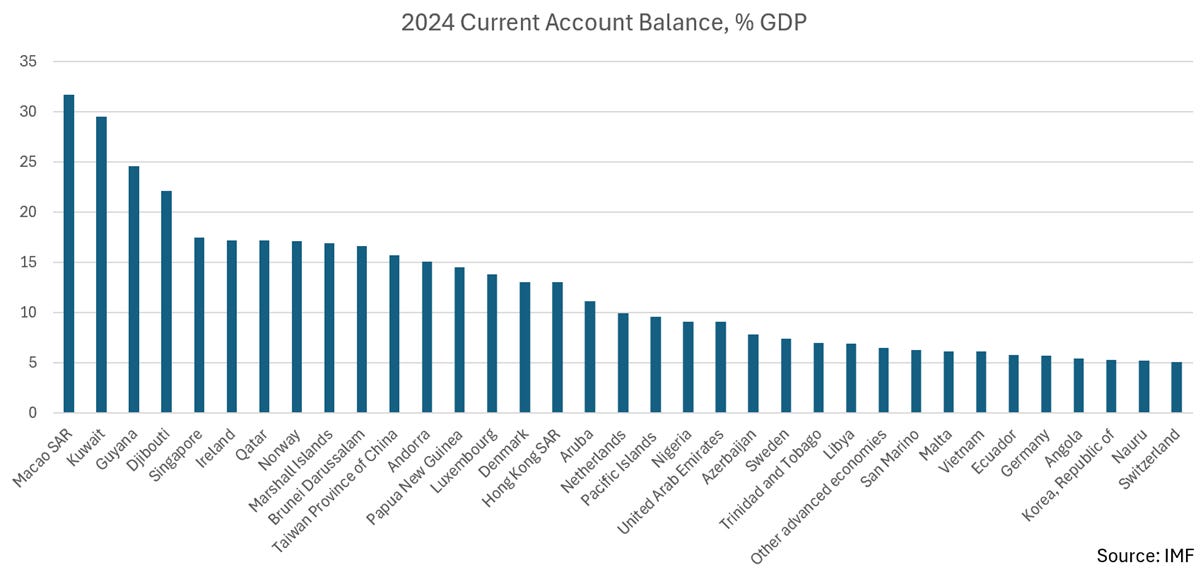
4. Current account surplus, financing reserve builds. Allowing the large current account surplus to enter your economy can boost your domestic economy, potentially triggering the famous Dutch Disease (where a commodity exporting sector strengthens the domestic currency so much that other sectors become externally uncompetitive). However, this situation allows international equilibrium to better be established and hey, it might be nice to allow your population to benefit from the fruits of all those hard earned export receipts. I guess we mentioned Dutch disease, which would make the Netherlands an example here, and also ancient (20th century) America. Let me know if I’m missing a current example… I provided a chart of all the major current account surplus countries below and as far as I know these basically all have either massive sovereign wealth funds or huge foreign asset holdings, i.e. they largely recycle their surpluses.
So we have
1. Current account deficit, financed by investment inflows → good for growth, until liabilities become destabilising.
2. Current account deficit, financed by reserve drawdowns → the country is on a timer, risks are elevated.
3. Current account surplus, financing investment outflows → no international rebalancing/currency appreciation, threats emerge as foreign assets are eventually repatriated.
4. Current account surplus, financing reserve builds → appreciating currency, but potentially good for growth elsewhere as liquidity enters the economy.
JB Macro is my blog, where I splurge out my brain. I’m building a following for my passion, writing about economics and markets, and it would be really great to have you on board. Please consider pressing the subscribe button below (it’s free!!). Thank you, James.
This newsletter is for informational purposes only. It does not constitute investment advice or an offer to invest. The views expressed herein are the opinions of JB Macro exclusively. Readers should conduct their own research and consult with professional advisors before making any investment decisions.