
Top 10 Macro Risks
Donald Trump Redux

Not sure about you, but we did not have half of the nonsense that has gone down this year on our macro bingo cards.
Besides Israel’s attack on Iran, most macro volatility has been driven by the big man, Donald Trump, whose maverick qualities have his Tweets and Truths instantly moving markets and dominating the news cycle.
It seems that Trump can change policy on a whim, moving markets as he pivots policy out of boredom while chilling in the Oval Office.
We did backtest this… and there is (surprisingly) no relationship between just how busy Trump is and market movements. We took the 961 presidential engagements as per rollcall.com between inauguration day and 26 June, and found that Trump having a quiet day (or weekend) did not lead to downside moves for US equities, the dollar, or treasuries (what a waste of time that exercise was lol).
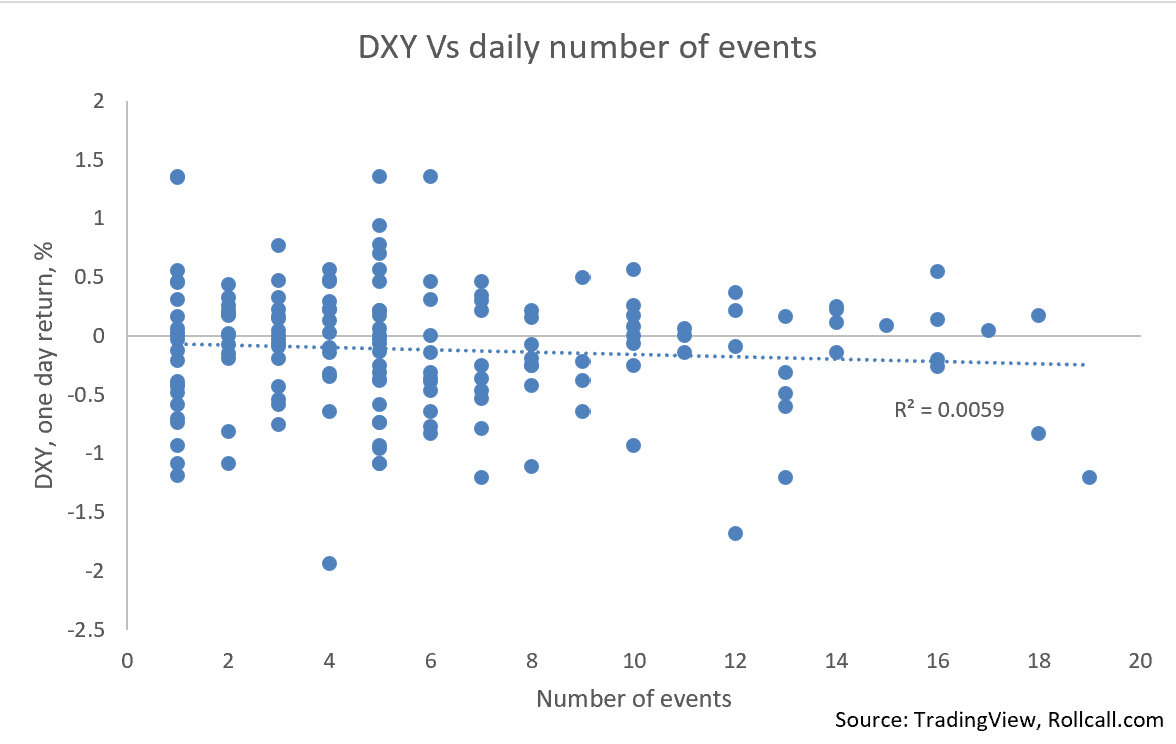
Anyway, Trump doesn’t get bored and bang out policy. But his actions certainly drive markets. Given government by tweet is a thing, it’s extra important to watch your tail risks in the current environment. With that in mind, we compiled our top ten macro risks for the next 12 months.
These are not forecasts, but it seems reasonable that one or two of these might happen soon. Enjoy :)
Top 10 Macro Risks
Planned dollar devaluation – First up, here’s one we wrote about back in April. Trump’s policies are virtually all consistent with a major dollar deval and the administration could stumble into this camp. Tariffs may not attract the concessions the Trump team hoped for from trade partners, and it’s pretty sketchy (read as unlikely) whether this will lead to major investment/reindustrialisation of the US (we explored last week how the notion that US manufacturing jobs were stolen by China is wrong). Similar to the 1971 Nixon Shock, the administration could opt to threaten huge tariffs on economies who do not agree to a coordination dollar deval. Alternatively, a swift loosening of monetary policy (see bullet 8) could have the same effect here, albeit at the expense of much higher US inflation (in fact, without a loosening of US monetary policy, sustained dollar weakness would be quite tough in line with Mundell-Fleming). Dollar down would be supportive of USD denominated assets but only domestic holders would benefit with overseas investors losing out.
Treasury weaponisation – Dollar deval would be in line with Stephen Miran’s (really weird) white paper on how to reshape the US’ international standing, which has been dubbed part of a potential Mar-a-Lago Accord. Another string of this insane platform is the US unilaterally extending debt maturities and lowering interest payments on treasuries. Make no mistake, this would be a default for the most important asset on earth, and would cause the most insane ructions across global markets. Even if this policy was just hinted at seriously, this would likely drive some insane movements. We’ve seen some early suggestions of this in Section 899 of the Big, Beautiful, Bill (🤮), the so-called Revenge Tax that was removed at the request of Treasury Sec Scott Bessent. We also could similarly see Trump threatening the validity of China’s massive pile of treasury holdings. On the flipside, China could threaten to dump treasuries, threatening global fixed income stability (China would be shooting itself in the foot a bit there given the value of its own holdings would suffer). This is all bad for treasuries, bad for the dollar, bad for risk, while DM government bonds with high correlation with treasuries (e.g. gilts) would likely also sell-off.
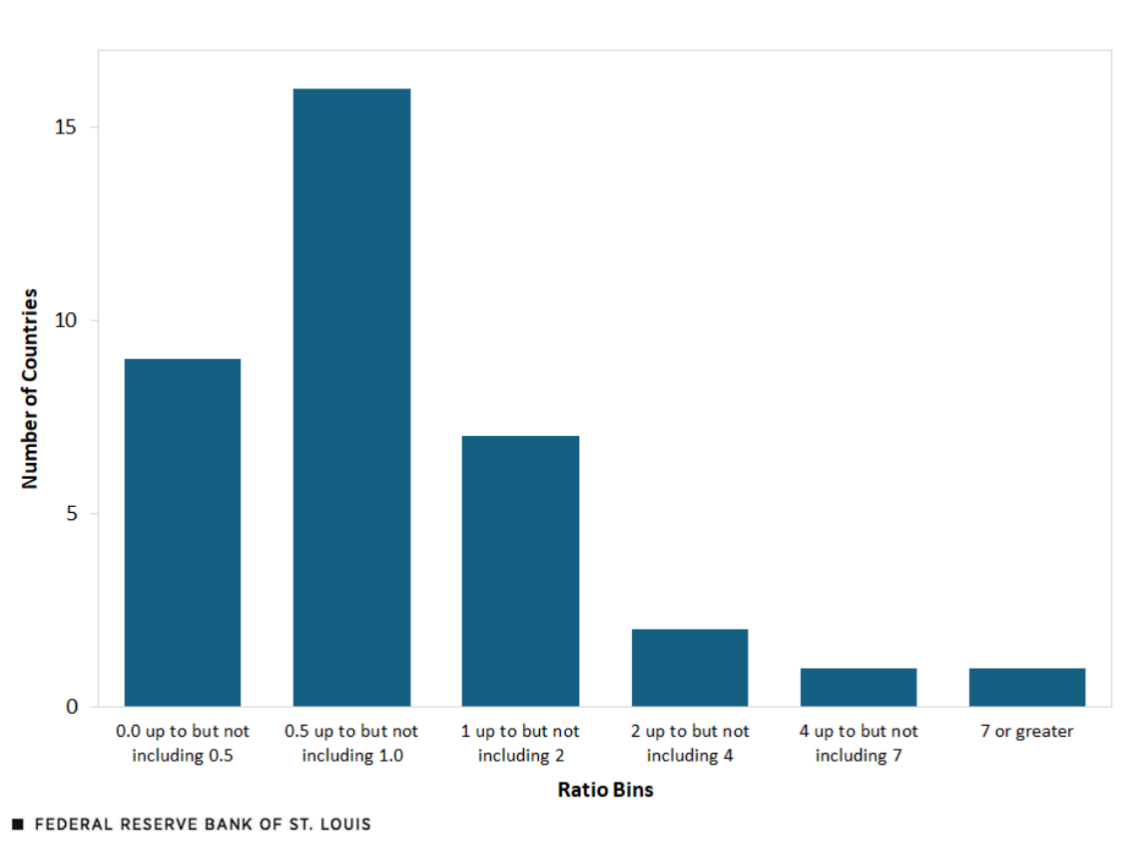
Global trade fragmentation – This theme encapsulates the idea that on 9 July, perhaps we don’t see the “reciprocal” tariff rates remaining at their temporary 10% level, instead shooting higher. Supply chains start to pivot, with goods transhipments increasing costs and near-shoring and on-shoring reversing the gains of globalisation. Perhaps retaliation from China starts to see it pushing countries where it has influence to reduce exposure to the US. In this risk scenario, we start to see the emergence of a more bifurcated trade system with the US leading one bloc and China the other. A surprising number of countries would likely come down on the China side of a divide, with China an important source of investment and of trade. This note from the St Louis Fed highlights a big shift between 2002 and 2022 with countries increasingly trading more with China than the US. The chart below plots ratios for countries’ bilateral trade with the US to bilateral trade with China (i.e. a number less than 1.0 implies the country trades more with China), showing of major trade partners, most traded more with China than the US in 2022.
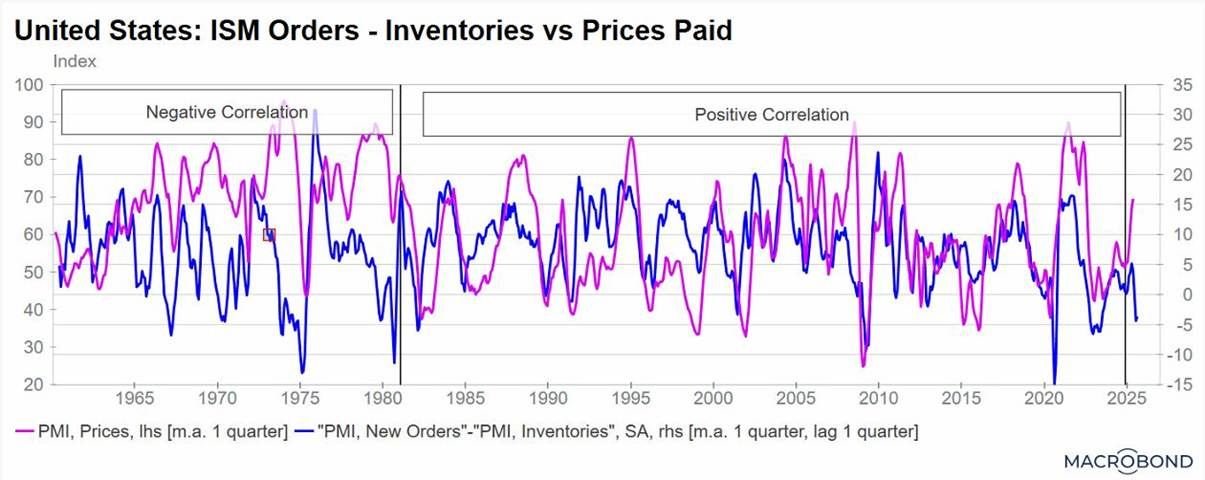
Corporate margin shock – Tariffs at their core are a major shock to the bottom lines of US corporates. They increase costs on imported goods, while the demand backdrop will limit the extent that firms can pass costs to consumers and maintain margins. There are already some signs that tariffs are eating into margins with the below chart (credit to Andre Chelhot) showing that firms are increasing prices while not replenishing their inventories, something we haven’t seen since the 1970s. This suggests that firms are not making sufficient margins in the current environment to restock. If these surveys are a good read on the coming hard data then we’ll see a big upset to a US equity market which is still priced for high S&P 500 earnings growth of 8.5% in 2025 and 14.0% in 2026. Another major cost headwind for firms is the shift in US immigration policy, removing a major source of abundant and cheap labour from the economy. Big shocks to margins would be bad for equities, bad for the dollar, while yields would be on the down as the Fed has to tilt to protecting the employment side of its mandate.
US economic shock & Fed stimulus – Tariffs and a major tightening in labour supply join other factors such as the legacy of DOGE tax cuts and massive economic uncertainty (see bullet 10) to upset what was a strong (albeit slowing) US economy at the end of 2024. We’ve already seen some weakness with Q1 GDP coming in at -0.5% annualised, while real final sales to domestic purchasers came in at a weak 2.0% annualised for the quarter per the third estimate. This measure is a key tell on demand in the economy, and when it was thought to be a robust 3.0% per the first estimate of GDP, it was a key defence of those claiming the US economy was still strong. Recently, we also saw major downward revisions to US employment data and there’s reason to believe we aren’t yet seeing tariffs in the inflation data due to the weak demand backdrop. All this could prompt the Fed to pivot policy with mind to a weak demand outlook, while second round effects from tariffs related cost pressures remain. Equities down, dollar down, yields down. Ouch.
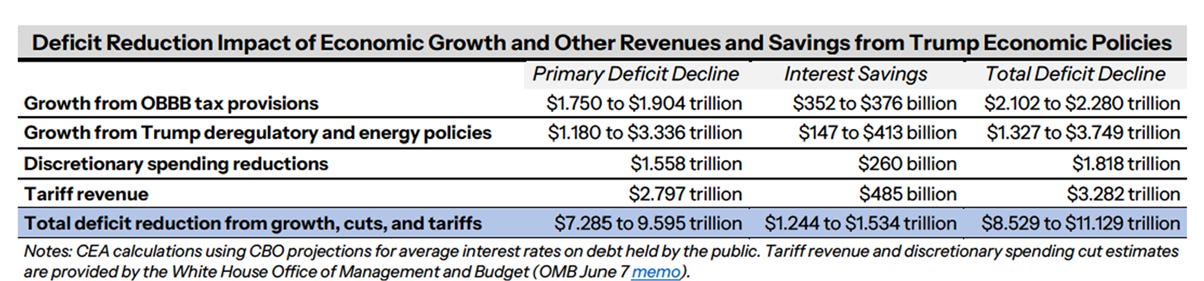
US fiscal reckoning – If you want a laugh, read through this analysis from the Council of Economic Advisers (headed by Stephen Mirran who we mentioned above). The paper makes some insane claims about the Big, Beautiful Bill, pushing the idea that tax cuts will drive some pretty insane economic growth (I thought we left this extreme side of supply side economics in the 1980s?). This includes USD3.8trn of tariff revenue… Wild. Anyway, we appear to be in the last innings of US fiscal profligacy, and a bill premised on ridiculous assumptions only lends itself to further blowouts US deficits. As a minimum, this should drive higher borrowing costs throughout the US economy. In a more extreme scenario, we could start to see some serious adverse treasury market moves. Yields up, dollar down? Sounds like capital flight to me.
Fed independence undermined – Here’s a real easy one where D Trump can make the USD and treasury markets crap themselves in one tweet (I am firing Jerome - too late - Powell). Trump has flirted with firing Powell, looking to install a dove instead. He appears to have moved away from this idea, but could confirm Powell’s replacement well before his term ends in May 2026. This would create a shadow chair, with markets increasingly paying attention to what this backseat driver is saying about policy. The Fed is not just the Chair and other members could vote independently; however, the US system puts much more power in the Chair than other central banks, with very little dissent in monetary policy votes in the US compared to elsewhere. Such a move would see pricing for lower short end rates, a weaker dollar, and further undermine market trust.
Geopolitical flashpoint – Recent years have been pockmarked by sudden extreme escalations of geopolitical risk, which could be further encouraged by the US no longer wanting to be the world’s policeman. Key areas to watch are well known, but markets increasingly seem happy to fade geopolitical risk, for instance with Crude barely reaching USD80/bbl on the recent escalations between Iran and Israel. This reflexive assumption that things will play out ok may prove incorrect in the near future, with key commodity supply impacted. It feels like there are far too many hotspots to name right now. Commodity prices up, equity markets down. On a surge for crude we might see the dollar do well due to the US being a net oil exporter, but subsequent synchronised sell offs for global equities would be bad for the dollar.
Greenland military tensions – Part of our framework for guessing what Trump might do is taking what he says literally, and the man says he wants Greenland. in today’s world, an unwelcomed US troop build-up in Greenland is not out of the imagination. This would spark diplomatic fallout within NATO given incursion into Greenland (an autonomous region of Denmark) would trigger NATO’s Article V common defence commitment. Trump probably would not mind a crisis in NATO, which he appears to despise. This would trigger a major ruction between the US and the EU (of which Denmark is a member) and while we likely would not see conflict, the Transatlantic relationship would be thrown into uncharted territory.
Confidence collapse – Finally, here’s one that pulls all of this uncertainty together. It’s incredible just how much global markets have shrugged off in recent months. If you’d have been (really) heavily sedated on 31 December and woke up at the end of June and checked your brokerage app, you’d see little changed in the S&P 500 or US treasuries (although the dollar is down sharply). There is no guarantee that this goes on. Survey data is replete with the notion that uncertainty (especially related to tariffs) is causing firms to pause investments, while uncertainty (for instance on the labour market) is triggering risk averse behaviour from households (e.g. savings rates have risen). Should we see a swift stream of more adverse headlines, this could drive a sudden major plunge in confidence, bringing with it some seriously adverse macro and markets effects.
There we have it, those are you’re top ten macro risks.
JB Macro is my blog, where I splurge out my brain. I’m building a following for my passion, writing about economics and markets, and it would be really great to have you on board. Please consider pressing the subscribe button below (it’s free!!). Thank you, James.
This newsletter is for informational purposes only. It does not constitute investment advice or an offer to invest. The views expressed herein are the opinions of JB Macro exclusively. Readers should conduct their own research and consult with professional advisors before making any investment decisions.
And here’s the 11th Macro Risk: https://open.substack.com/pub/kingcambo812/p/sunday-screed-the-mother-of-all-crashes?r=bfraz&utm_medium=ios