
What Will Andy Burnham Do As PM
A Deep Dive Into “Manchesterism”

Back in February, we concluded a three-part series on what policy would look like if Andy Burnham became UK prime minister. By the time we published the third part, Burnham’s prospects of taking the top job had got so bleak we noted the work as increasingly feel[ing] like an academic exercise into how the policy platform of a non-London centric, semi-socialist, semi-capitalist might look.
No more. Andy Burnham has overcome the parliamentary loopholes he had to jump through, with a weakened Starmer no longer able to prevent him from contesting a by-election and becoming an MP. With Burnham in parliament and Starmer having handed in his notice, if a contender does not emerge from the Parliamentary Labour Party (PLP) come 17 July, Burnham will be crowned king of the jungle the UK’s sixth prime minister in 10 years. That outcome is an almost certainty per odds from Polymarket:

Now, journalists and analysts alike are suddenly becoming specialists on Burnham and his policies. We on the other hand have 6000 words published, have laid out his ideology and his policy views, and even read his (very interesting) book (with Steve Rotheram).
In this deep dive, we will explore what we have learnt about Andy Burnham’s policy agenda since we published our three parter, before cracking back open our prior notes on his ideology and what we learn about Burnham from his book.
What We Have Learnt Recently
Watching Burnham’s speech on 29 June, you’d have been forgiven for forgetting he was but a lowly backbench MP. His first speech since rejoining parliament was front page news.
Central to the performance was his advocacy for devolution, with the launch of “No 10 North”, to be based in Manchester (the greatest city in the UK), as part of “the biggest rebalancing of power our country has seen.” In Burnham’s view, it would move a significant portion of government power out of London, and be “the conduit through which we redistribute power and resources across the UK.”
No 10 North would take the lead on reindustrialisation, a 10 year plan to regenerate towns and high streets, and reform of essential utilities. This is consistent with Burnham’s rejection of Thatcherism, and more explicitly his advocacy of much greater government involvement in the economy (which we view more in the industrial strategy vein than as broad nationalisation).
The rejection of Thatcherism was also evident in his commitment to the “biggest council house building programme since the post-war period,” with his analysis putting poor housing policy central to poor fiscal outturns and dissatisfaction among the electorate. There are big open questions on how said houses would be financed given fiscal constraints, but our intuition is that he could lean on public-private partnerships and private sector investment flows to finance these, made more attractive by coupling the projects with easier planning rules (a combination he used with great success in Greater Manchester).
Elsewhere, he called for:
Business rates reform for pubs and high street businesses
Rolling out Greater Manchester-style “good growth funds”
Greater equivalence between academic and technical education (as he pioneered with the Greater Manchester Baccalaureate)
“not using the whip system to create fear or close down debate”
Burnham more broadly committed to making change in line with 2024’s manifesto. As we outlined on Monday, this did not seem necessary: ultimately, governments are judged come the next election on how well people feel they have done (often just a product of how much real disposable incomes have advanced through the term). There are no points for having overseen a shitshow but not breaking any manifesto pledges. However, the manifesto still contains a many decent ideas that are aligned with Burnham’s ideology that appear to be largely untouched by the Starmer government.
Most notably, Burnham committed to maintaining Labour’s fiscal rules (not that they make much sense), and also to not raise income tax, NICs, VAT, or corporation tax. That leaves much smaller levers available to pull in order to raise revenue for the large changes that he wants to make. On tax increases he could introduce, he has loosely spoken on shifting taxation from council tax to a land value tax (which could raise more money), and introducing wealth taxes. And in terms of shifting who pays tax, he’s mentioned reducing small business employer NICs, reducing business rates for smaller firms (offset with higher rates on distribution/warehouse businesses) and replacing inheritance tax with a social care levy. Meanwhile, he has said he wants to “develop a policy” to address fiscal drag which is pumping up the income tax take significantly (good luck trying to do that given it is projected to be the key incremental revenue raiser over the next half decade).
Another key aspect of Burnham that came across during the speech and likely will be crucial over the coming years is his ease with politics. He joked with the audience in a performance that was clearly much more charismatic than anything Starmer ever managed (quite a low bar), and he managed to appear, (dare I say) normal.
With mind to this northern charm, there are two arguments doing the rounds, one of which is that Burnham would just be a more charismatic version of Starmer (a criticism) and the other that Burnham only need be a more charismatic version of Starmer to deliver the apparently strong agenda that Starmer struggled to sell to the public (a compliment).
Neither seem to be overly sensible.
Burnham is clearly not just Starmer in “Manchester clothes” as Burnham called them (image below). He has long standing policy views and a strong ideology as we will discuss below. He is not a charismatic Starmer clone.
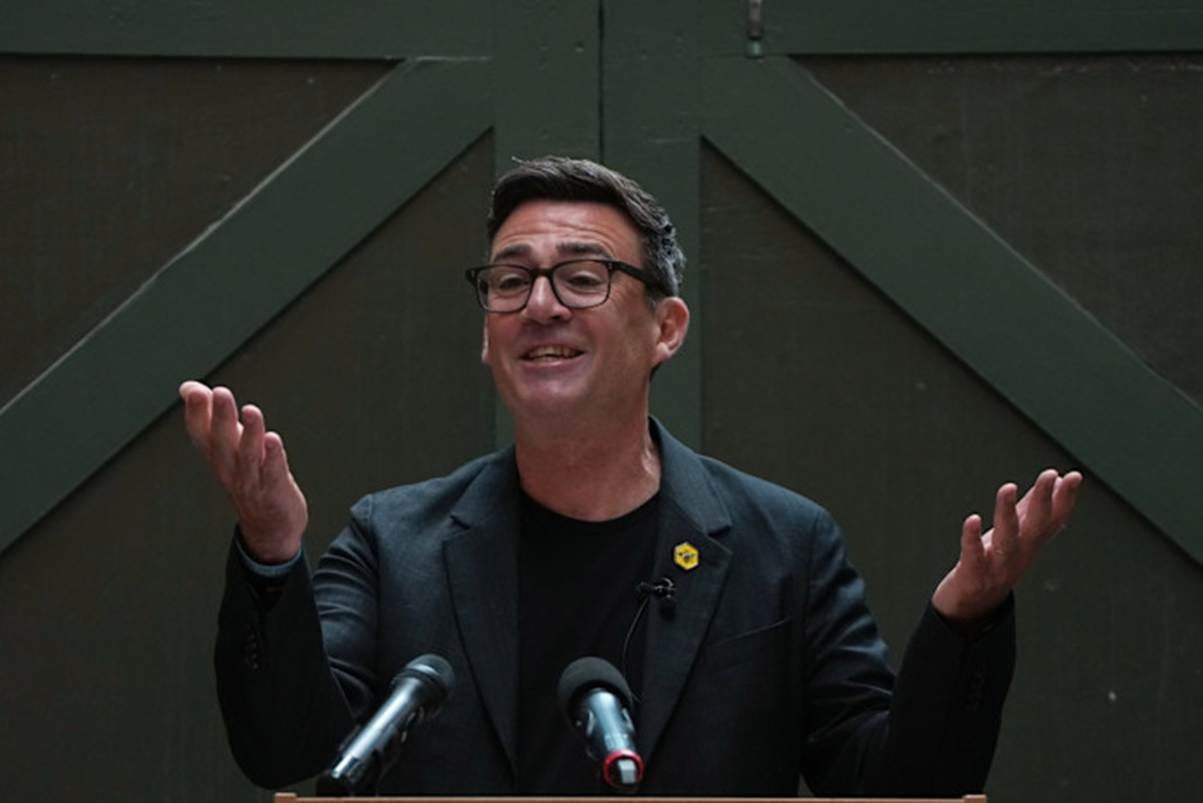
The other, that Burnham need only be more charismatic due to the apparent strength of Labour’s existing agenda falls at the first hurdle – the smell test.
First, it should be noted that there are a whole series of reviews that have been completed under Starmer that can put real rigor behind coming legislative changes. This includes the Strategic Defence Review (delivered June 2025, although the government has baulked at investing in line with its recommendations), the Timms review into PIP (due late 2026), the NHS 10-year plan (delivered July 2025), immigration white paper (delivered May 2025), child poverty strategy (delivered December 2025).
In this respect, sure, Burnham can hop into Starmer’s shoes and pick up the agenda where his predecessor left it. However, Starmer did not just lack charisma. He was a terrible administrator (Mandelson), terrible strategist (U-turns), terrible legislator (PIP cuts), and terrible manager (Gray Vs McSweeney). Burnham will need to be so much more than just a more charismatic Starmer. He will need big policy ideas, to be a canny political operator, and have a considerable amount of luck.
While recent weeks have allowed us to glean more than we knew about Burnham, there are still a lot of unknowns. It is not completely clear how his agenda will be funded. We don’t have much of a lead on who his Chancellor would be. We don’t know where he stands on huge areas such as foreign policy, especially given he has been more critical of the US already in the last month than Starmer ever has. We also know he is very pro infrastructure projects such as restoring HS2, but have no lead on how much of a priority that would be amid fiscal constraints (or whether we would see another attempt to kick it to private partners). Finally, he has indicated he wants to do something about reducing benefits, while helping those coming off benefits get into work, but he hasn’t specifically addressed where he stands on the Timms Review or whether he thinks PIP should linked to work.
That said, we’ve extracted everything we can from his recent comms on policy. However, to really understand what Burnham might do as PM, we’re going to have dig a little deeper. In the next section, we explore his ideology.
Burnham’s Ideology
In piecing together a cohesive narrative of Burnham’s political views, we found it best to focus on one political ideology – “business-friendly socialism” as he calls it – and three key, overlapping strands of policy – fiscal policy, devolution, and industrial strategy.
The Ideology: Business-Friendly Socialism
First up then, what on earth is business-friendly socialism and can we think of something more oxymoronic? Looking beyond an overly-literal take of the phrase, Burnham combines soft left instincts with an appreciation that working closely with the private sector is necessary to get the best results. It is unclear whether sympathy for the private sector is realpolitik or a core part of his political philosophy.
For instance, considering his soft-left stances, Burnham has consistently called for greater control of several previously privatised industries such as water, energy, and transport (all of which are judged to have failed in the private sector). A long-running goal of his has been to create a National Care Service, bringing social care into the public sector as a parallel to the National Health Service (a policy which he introduced as health secretary in the late 2000s but was reversed by the Coalition government).
Burnham also has been clear in his belief of where Britain’s faults lie: “the four horsemen of Britain’s apocalypse, deregulation, privatisation, austerity, and Brexit… combined to leave the country in a low growth doom loop” with at least the first three of these being traditional socialist focusses of angst. His foreign policy instincts also appear grounded in the soft left, and he has variously advocated leftist policy including a wealth tax (although he has indicated he would prefer a land value tax) and proportional representation (to replace FPTP).
On the flipside, Burnham has repeatedly made policy decisions as Mayor which have been criticised for putting businesses first. For instance, he suspended affordable housing quotas in order to negotiate better terms with developers, and the Manchester Life joint venture launched in 2014 between the council and Abu Dhabi United Group has continued to thrive under his mayorship, regenerating previously derelict areas of the city. Criticism came in this venture for the sale of 999 year leases to a foreign organisation and the waiving of subsidised public housing requirements. Burnham’s tenure has seen a Manchester City Council which has been very permissive in planning, triggering a boom in city centre construction, and he has been perceived as surprisingly favourable to the private sector.
Overall, it appears that Burnham has philosophically, or at least practically, reached a compromise between his soft left instincts and an appreciation of the private sector’s ability to get things done and as a crucial source of capital. His instincts remain redistributive, collectivist, and internationalist, which his Wikipedia page tells us forms his philosophy of “aspirational socialism”, another oxymoron which we will leave you to unpack by yourself.
Policy Area 1: Fiscal Policy
Reporting on Burnham’s leadership bid soft-launch in September was dominated by a single line in his profile in the New Statesman: “We’ve got to get beyond this thing of being in hock to the bond markets.” This even became core to the key attack line for PM Keir Starmer against Burnham’s move.
In the following months, prospects of a Burnham premiership were associated with expectations of higher deficit spending and greater gilt issuance. This is a serious issue given gilt investors are still twitchy in the wake of botched budgets from both the Conservatives and Labour in recent years (the experience of the former being much, much worse than the latter) and with the UK already running a wide fiscal deficit with high public sector debt.
However, it is not clear that Burnham’s “in hock to the bond markets” implies as much of a free spending soft-left politician as many might assume, a stance that has been supported in recent weeks by a lack of obvious twitchiness in financial markets as his premiership became almost guaranteed.
As a caveat to start with, it is worth pointing out that it is not a sensible idea at present to associate yourself as a politician with denying the importance of the bond market. UK borrowing costs remain elevated on the back of the Truss Mini-Budget, meaning households are paying higher mortgage costs for a prior PM not believing that the government needed to respect the bond markets. It is not a good look if every time the prospects of your taking power rise, gilts fall. More broadly, if you don’t want to be in hock to bond markets, then don’t borrow from them.
After caveating that seeming political misstep, it is worth noting that when Burnham discusses the UK being “in hock to the bond markets”, it is not necessarily to say that the country should spend freely and ignore market based constraints. More so, it is acknowledging the market based binding constraint on UK policymaking as a result of terrible economic outturns over recent years, and of a need to address this situation.
For instance, in the New Statesman profile, he first talks about the need to “end the market instability hanging over British politics” before discussing no longer being in hock to the bond market.
This point comes across more explicitly in a separate article on the Greater Manchester Combined Authority website: “The austerity and Brexit of the 2010s deepened the hole by hollowing out English cities and towns, and of course our councils. It has all combined to leave the country in a low-growth doom-loop. Our shallow, adversarial political system has shown itself incapable of lifting us out of it, and only adds to the volatility. So we find ourselves stuck in a rut and in hock to the bond markets.”
While this may be an overly generous take (and please send over any evidence to the contrary), it suggests a more nuanced take on Burnham than an irresponsible socialist free spender. While Burnham’s messaging could be consistent with greater deficit spending than the Starmer-Reeves combination, his near-term goals appear more focussed on boosting growth (via investment) as a means to alleviate market based constraints on spending as opposed to more traditional socialist goals.
Policy Area 2: Devolution
Burnham’s fiscal and industrial policy is deeply entwined with an overriding vision for the country; huge advancements in devolution. Manchester has been the UK’s fastest growing city over the last decade, and Burnham has had many policy successes as mayor, which seemingly derive at least in part from devolved powers since 2014. However, in Burnham’s view, devolution has not nearly gone far enough.
If Burnham were to characterise the core flaw in the country, it would almost certainly be that the institutional set up favours London and the South East at the expense of the rest of the country. Devolution is Burnham’s means to address this.
For instance, this would include devolution in fiscal policy (more capability for devolved regions to tax and spend), industrial strategy, and post-16 skills devolution (so regions can provide technical education in line with their own “global clusters”). It would mean everywhere would have a devolved combined authority government, with substantial policymaking ability, providing the ability for policymakers to focus on what is best for local economies.
This would incorporate a huge reduction in the powers of central government, and would mark a historic institutional shift.
Alongside it, Burnham has advocated policies such as huge changes to the Treasury’s Green Book (the method for appraising investment projects, which typically favours investment in London and the South East due to higher economic returns), the Barnett formula (the formula to calculate block funding grants to Northern Ireland, Scotland, and Wales), and also revaluation of the council tax base (council tax is based on historic valuation from 1991, which means areas of high house price growth, for instance in London and the South East, pay less tax than they would under current valuations).
Policy Area 3: Industrial Strategy
Our final theme is industrial policy, which a Burnham premiership likely would bring an intense focus on, with his mayorship defined by several examples of focussed attempts to develop regional economies. This is most evident in progress on Greater Manchester’s five global clusters, five locations across the region which specialise in “pioneering sectors”.
Core to this development is a policy backdrop focussed on easing barriers to investment and job creation, for instance via creation of a joint development plan to handle land allocation, a ten year project pipeline (offering certainty of demand for the private sector), and a focus on providing education in the areas relevant for these sectors (e.g. the Greater Manchester Baccalaureate).
These policy aims are explicitly in collaboration with the private sector, in line with Burnham’s “business-friendly socialism”, and are in line with the current government’s goals of using investment spending to crowd-in the private sector.
At a national level, devolution would likely go hand in hand with localised industrial strategy, with individual regions likely expected to produce their own approaches, focussing on areas where they are globally competitive. This would naturally put the government semi-detached from decision making, limiting the role of the prime minister and parliament in decision making, but that sounds like exactly the point.
A core focus to be encouraged alongside solid industrial strategy would likely be a major focus on improving the UK’s transport, under public ownership. The greatest success of his premiership has been widely judged to be changes made to Greater Manchester’s Bee Network, creating a London-style integrated transport system which is planned to incorporate commuter rail from 2028. This could include a revival of the Northern leg of the HS2 rail network, the scrapping of which Burnham very publicly opposed.
So we have an ideology and three policy strands as a means to frame what the man would do in number 10 (unsure at present if that is the London number 10 or the Manchester one now though).
The Head North Plan (What we learnt from Burnham’s book)
With our views on Burnham’s ideology and priorities laid out, there isn’t much more we can tell you. The good thing here is that while we don’t have much more to add, we can hear more from the horse’s mouth with a dive into Burnham’s book with Mayor of Liverpool City Region Steve Rotheram, Head North, published in 2024. The entire second half of the book is dedicated to a ten part “Head North Plan” for UK policy, the need of which is justified as:
People can see Britain slipping backwards and dislike feeling powerless about it. What has not yet been established is a broad public consensus about the form that change should take. The Head North Plan is a serious attempt to fill that void… Each of its ten points involves a transfer of power to people and places and, taken together, are intended to create the conditions for a more functional, fairer country.
From here, it makes sense to just get to it with a deep dive on the ten points. Quotations are quoted from the book, the rest are our interpretations. We have mish-mashed quotes from various sections of the book to piece together the summaries below. The book splits text between Rotheram and Burnham; we have been careful to quote mostly from Burnham, but on occasion it made sense to quote from Rotheram, although we have only done so where it is clear that Burnham holds the same view.
This plan clearly stay very relevant to Burnham’s policy focus, with points 2, 4, 6, and 7 in the headlines since he became the clear favourite to replace Starmer.
The Head North Plan:
1. A Written Constitution – This section puts a large portion of the political dysfunction of the UK (including its favouritism towards London and the South East) at the foot of the lack of a written constitution (“practically every other country in the world – over 190 of them – have a written constitution”). “Our unwritten and murky constitutional arrangements have had the effect of hoarding power in a small number of hands – in Whitehall and Westminster… making it all too easy for vested interests to hack the system and exploit grey areas for their own benefit”. The written constitution would aim to rebalance power away from the centre “towards the local and regional level”, naturally with a heavy emphasis on devolved power. Our take: While noble, it is not clear that this is politically possible (it would place huge limits on parliamentary sovereignty and it is unclear what would be needed to introduce it) and it is also unclear that this would fix the UK’s problems (the content of the constitution would matter more than the existence of a constitution itself). In terms of fixing the UK’s political problems, this does not appear a major priority, and the attempt to introduce a constitution would likely cause so much political discord that it would completely dominate all other policymaking.
2. A Basic Law – This point is heavily influenced by the German fiscal arrangements with its own devolution to the “Länder”, a political set up that the UK helped create after the second world war (Germany’s “Basic Law” is this point’s namesake). This would involve a much more equitable sharing of government investment, as opposed to the current method which prioritises investments which have higher economic return (thus mostly rest in London and the South East). “It means a requirement in a new UK constitution of equivalent living standards across the regions and nations… the constitution would need to contain a commitment to equal and fair funding for all places consistent with the Basic Law. The time has come to tear up the Green Book [the Treasury approach for determining fixed investment allocations based on economic returns] and the Barnett Formula [the current method to allocate funding to devolved regions based on spending in England] and replace them with a modern funding formula… Under the new formula, funding would be allocated to the region and nations based on social factors and levels of need. If we do [this], the dream of a Britain with equal living standards becomes a distinct possibility.” This would be incredibly consequential, and would result in huge scale reallocation of investment from London and the South East to the rest of the country. The argument against this is that this would be that it incorporates inefficient investment spending, which the country can ill afford especially at present. The argument in favour is that if the government leads this investment, it could create more economically vibrant local economies (which could even pass the muster of a hypothetical return of the Green Book test), and also would address regional inequality and populism. Our take: reforms to existing investment rules under the Green Book (which the government have tentatively started) to reduce regional inequality are long overdue, with the last decade and a half showing how politically fractious it is to have such an unequal country. However, linking this to an outright constitutional commitment seems like too much of a stretch to be politically possible. Rather, it would seem more feasible for the government in power to 1) change the Green Book rules; 2) rule long enough to see the success of this change; 3) have it established as a sensible enough rule that opposition parties do not reverse it when they return to power.
3. Reform of the Voting System – “In my view, 140 years of the first-past-the-post system cannot be said to have done anything to reduce regional inequalities… If anything, the first-past-the-post [FPTP] system has only strengthened the grip of the London-based establishment on the running of the country. London-centric policies proposed by successive governments have not been effectively challenged by Parliament and regional inequalities have seriously widened right under its nose. We need to correct this. Alongside the removal of the whip system, we should move to a system of proportional representation for the election of the Commons.” Burnham is heavily against the UK’s FPTP system, which awards constituency seats to the member who got the most votes, with those coming close behind getting nothing, regardless of their popular vote. This can lead to parties which win relatively small shares of the popular vote winning massive majorities in parliament. For example, Labour won 411 of 650 seats in the 2024 election, on a popular vote of just 33.7%. The Conservatives only got 121 seats with their 23.7% share, and Reform 5 seats with their 14.3% of the vote. Introducing proportional representation would make parliament better represent the political views of the country, but at the cost of less decisive elections and the frequent need for coalitions, reducing policymaking ability. Burnham argues that PR would mean politicians would need to make the country more equitable, which could be the result of such coalition building. Our take: PR would indeed increase representation; however, at the cost of policymaking ability. There are good points and bad points here. First, a good point of PR is that the votes of groups marginalised in the current system begin to matter, and the current system of people not wanting to “waste their vote” in voting for a smaller party disappears. This would clear the way for a wider variety of parties to emerge (as appears to be happening anyway at the moment), with voters no longer having to choose between a single centre-left and a single centre-right party that varies over time between being hard/soft left/right economically/socially. This would be good for the political debate and would increase engagement in policy. The bad here is that this would massively fragment parliament, meaning governments effectively always have to govern as part of coalitions (for an example of how this looks in practice, check out Portugal which has had to have elections in 2019, 2022, 2024, and 2025). This would massively strain policymaking ability, while increasing the chances of radical parties to influence the policy agenda.
4. Removal of the Whip – There are some policies which governments advocate, and then soon come to desperately regret. For instance, Tony Blair’s introduction of the Freedom of Information Act which he later chastised himself for in his autobiography, which I quote at length here because it is funny: “Freedom of Information. Three harmless words. I look at those words as I write them, and feel like shaking my head till it drops off my shoulders. You idiot. You naive, foolish, irresponsible nincompoop. There is really no description of stupidity, no matter how vivid, that is adequate. I quake at the imbecility of it.” The removal of the whip smacks of being another such policy. Burnham rightly points out that “the whip system disempowers MPs, diminishes their status, and over time, disconnects them from their constituents.” This comes as the centre dictates how MPs vote, meaning they often end up voting in support of legislation which they desperately disagree with, otherwise risk seeing their prospects of a job in the cabinet disappear. Our take: Removal of the whip is noble but dysfunctional. The problem of course is that the whip system is designed to improve the government’s ability to conduct policy. Removing the whip system inhibits the ability to conduct policy, especially given the wide range of views within political parties across a vast range of issues. Burnham mentioned the moderation of the whip system in his 29 June, but he may not go as far as calling for its complete removal when he may need it to govern.
5. A Senate of the Nations and Regions – “we are calling for the removal of the House of Lords in its current form. We would like to see it replaced by an elected Senate of the Nations and Regions of the UK, as recommended by Gordon Brown. It should remain as a revising chamber, scrutinising the work of the House of Commons, but it should be elected and representative of the whole country.” Reform of the House of Lords is a long pursued goal of the left in particular, and has progressed under the current Labour government. The current set up consistently stinks of being undemocratic, it being an unelected chamber, and having the ability to frustrate the policymaking process. For instance, the Assisted Dying Bill, which was passed in the Commons in June 2025, faced an insane number of amendments (over 1000) in the Lords and ultimately failed in a successful filibuster as an April 2026 deadline for its passage came and went. This saw a bill which is popular with the public and passed in the Commons by elected representatives be brought down by a chamber of unelected representatives. Our take: Major reform/replacement of the Lords would be appropriate to enhance UK democracy and policymaking and it feels appropriate to reform/replace rather than just abolition given the second chamber offers an important check on legislation. However, it is not clear what the best way to approach this would be. Burnham and Rotheram suggest that “Ideally, it would be as simple as asking the public to cast two votes at the General Election.” However, this approach would make the Lords just a second elected chamber, voting along party partisan lines, in the same manner as the US’ dysfunctional system. It is difficult to identify an appropriate way of appointing members, but it is quite easy to identify the attributes of the members that you want: thoughtful, intelligent, non-party political members who will approach the job with energy and serve longer terms than the commons. Five year election cycles alongside the Commons vote wouldn’t find this balance, but another system might.
6. Full Devolution – As we discussed above, a core strand of Burnham’s ideology is devolution, which the book suggests is centred on 1) a long held view that the North gets a rough deal; 2) his experience of the dysfunction and London-centric nature of Westminster; 3) his successes as mayor of Greater Manchester (most notably in transport). The drive for greater devolution is put into relatively lofty terms “If we can arrive at a point in 2034 where all parts of the UK have devolved arrangements, underpinned by a written constitution and a basic law… then it is possible to see how the course of the rest of the twenty-first century might be a more positive one for the UK than what it will be if we stick with the status quo.” Our take: Of all of the aspirations set out in the Head North Plan, this is perhaps the most easily practicable and one of the most likely to have a positive economic impact, while addressing regional inequality. It is a tad much to expect full devolution plus a written constitution plus a basic law by 2034, but there has been solid progress on devolution in the last couple decades and there is clear momentum behind the issue, emboldened by the successes of metro mayors such as Burnham. In particular, growth and skills policy which are attuned to the needs of the regions, as is discussed in point 7 and also our part 2, appear a key growth lever that has thus far been left largely unpulled.
7. Two Equal Paths in Education – “I want as many people as possible to go to university. But I don’t believe it is inherently better than a technical path.” Education in the UK sees students funnelled into the university pathway, regardless of whether they are likely to succeed in making it into a university or improve their career prospects via completion of their course-uni combo, resulting in a huge swathe of students whose needs are neglected, and are making inappropriate decisions at a pivotal point in their life for their career. Our take: it makes sense economically and socially to offer an equal technical training track, with Burnham’s suggestion that this should join devolved powers in education to allow technical education to focus in the sectors that the region specialises in an added bonus. This combined with devolution and broader industrial strategy could prove a powerful growth engine over a multi-decade time horizon.
8. A Grenfell Law – “That ideology of deregulation discussed at the Grenfell Inquiry is one that has dogged Britain and put people at risk. We have heard Conservative politicians boasting about a bonfire of red tape, referring to the reduction and removal of regulations. This is about making it easier for developers to build properties and for others to make money from it. Whether we are referring to the deregulation of housing, transport, health and care services or banking, it is all about making money – if it puts people at risk, well to hell with them, basically.” Our take: Grenfell was a national tragedy and a stark example of the ills of untampered capitalism. However, it did result in 2022’s Building Safety Act, legislation created with the angst of tragedy behind it. That being said, the legislation is naturally very onerous on developers and it is unclear that there is much more left to be done here. Otherwise, the so called “bonfire of red tape” seems quite necessary in the main, with both sides of the political divide recognising just how difficult it is to build in the UK, not because of crazy health and safety laws, but for things like the vast number of interest groups who get an effective veto on development. Policy which moves toward more regulation (as Labour have done in the labour market and house rental markets) and away from deregulatory surges (as Labour have done in planning) will be a net bad.
9. A Hillsborough Law – “The Hillsborough Law is a considered attempt to rebalance the scales of justice by using the experiences of the Hillsborough families to stop others going through the same nightmare; to correct some of the massive flaws in our legal system and offer a fairer process… We believe this pattern of injustice can only be broken by the passing of a comprehensive Hillsborough Law. We will never level up the scales of justice in favour of ordinary families unless we change the balance of power. There are two core elements to the proposed law: first, a legal duty of candour on police and public servants to tell the truth at the first time of asking; second, parity of legal funding for bereaved families at inquests where the state is involved.” Our take: It is quite difficult to put a solid argument up against this law, which is currently progressing through parliament under Labour as the Public Office (Accountability) Bill. Big questions remain surrounding where legal funding will come from given the tight fiscal backdrop, and limits to the duty of candour (e.g. for intelligence staff).
10. Net Zero to Reindustrialise the North – “The change to a more localised approach is the way energy is generated and distributed. It would allow an opportunity to change the business model. It would allow new forms of ownership to be introduced into the mix, such as cooperatives and social enterprises, which would keep more of the wealth generated in the North West. Public ownership of infrastructure, like the Mersey tidal barrier, present the same opportunity to recycle the benefits through our communities in the form of lower bills and better homes. Someone has to lead the green energy revolution in Britain so why can’t it be us? After all, we’ve led an industrial revolution before.” Our take: This sounds remarkably like Labour’s National Wealth Fund, which is focussing on investment in the energy transition as a means to spread investment and jobs around the country. This feels like a welcome focus on industrial strategy, which has largely not existed for decades. Time will tell how successful this effort will be.
To Close
Andy Burnham clearly is a remarkable politician. He appears set to become Labour Leader (and PM) on his third attempt, having had a go in 2010 and 2015. He has the charisma that Starmer always lacked, but he also has other skills which should not go unnoticed. His “business-friendly socialism” likely leads people astray, with undue focus on “socialism” and not enough on “business-friendly”. He also likely has received unfair treatment in assessments of his likely fiscal policy, although the negative narrative has fallen away in recent weeks as he committed to keeping the Labour fiscal rules. Elsewhere, expect to see devolution and industrial strategy as key overlapping strands of Burnham policymaking. A major criticism of government involvement in the economy is that government is too far away and detached to make decisions. That issue could be circumvented with devolved powers, leaving local leaders in charge of local interventions. This could create a powerful growth engine over the coming decades.
And we’ll leave you with that, Andy Burnham in 6000 words (ish).
JB Macro is my blog, where I splurge out my brain. I’m building a following for my passion, writing about economics and markets, and it would be really great to have you on board. Please consider pressing the subscribe button below. Thank you, James.
This newsletter is for informational purposes only. It does not constitute investment advice or an offer to invest. The views expressed herein are the opinions of JB Macro exclusively. Readers should conduct their own research and consult with professional advisors before making any investment decisions.